
 By
By Close reading is a powerful analytical approach used to understand literature and other texts on a deeper level. Close reading reveals underlying themes and ideas by examining the details, language, and structure, making it an essential skill for students, educators, and anyone who wishes to engage deeply with a text. This article will explore the concept in detail, including its meaning, strategies, and practical applications.
What is Close Reading?
Close reading involves a detailed and focused interpretation of a text. It aims to uncover the complexities of literature by examining elements such as language, structure, and meaning. Instead of merely skimming through a passage, close reading requires a meticulous examination to reveal the deeper layers of a text. This technique allows readers to engage critically, uncovering hidden meanings and connections that may not be apparent on a surface-level reading.
Close Reading in Practice
Close reading is not limited to literature. The strategy can also apply to nonfiction, historical documents, or even visual media. In all these contexts, the focus is on understanding both what is being said and how it is being said. The approach highlights the importance of analyzing word choice, stylistic elements, and structural features to grasp the text’s full impact.
Unlike other types of reading, close reading requires readers to pay attention to every word, phrase, and stylistic choice. While general reading aims for comprehension, close reading strives to understand the nuances, ambiguities, and subtleties embedded in the text.
Close Reading Definition for Students
For students, close reading is a careful and purposeful technique focusing on understanding a text’s more profound meaning. It involves paying close attention to the choice of words, sentence structure, and literary devices to determine how they contribute to the text’s overall message.
Close reading is crucial because it enhances critical thinking, comprehension, and analytical abilities. These skills are valuable in literary studies and across various academic subjects, where the ability to understand and interpret texts is fundamental.
The Close Reading Analysis
Analysis is at the heart of close reading. It involves breaking down a text to understand its components and how they contribute to the whole. When conducting a close reading analysis, readers should look for themes, symbols, tone, and other vital elements that provide insight into the author’s intent.
For example, identifying recurring motifs or patterns can reveal central themes, while analyzing figurative language may help uncover hidden meanings. Shifts in tone or style indicate changes in the text’s focus or mood, providing further clues to the overall message of a text.
Close Reading Strategy
Effective strategies are needed to conduct a successful close reading. Annotation, highlighting, and note-taking are vital tools in this process. Readers can actively engage with the material by marking up the text and jotting down thoughts and questions either in the margins or in a dialectical journal.
Another important strategy is to re-read the text multiple times, each time with a different focus. During the first read, aim for a basic understanding. Subsequent readings should delve into specific aspects like vocabulary, themes, and literary devices. Approaching the text like a “detective” searching for clues can help readers unlock the text’s deeper layers.
How to Close Read
Practical steps for close reading involve:
- Reading the text slowly and carefully: Take time to understand each passage, noting any unfamiliar words or phrases.
- Highlighting important passages: Mark sections that seem significant or puzzling. Write marginal notes to capture initial thoughts. Focus on questions you have about the passage.
- Looking for key elements: Pay attention to tone, language, imagery, and symbolism. Identify any shifts in perspective, tone, or structure.
- Asking questions: Reflect on why the author might have made certain choices and how they impact the overall meaning.Practical steps for close reading involve:
Steps for Close Reading
Here’s a step-by-step guide for conducting a close reading:
Step 1: Read the text thoroughly for a basic understanding.
- Aim to grasp the general message or ideas presented in the text.
- Pay attention to the text’s structure, organization, and key points. Look for structural elements like breaks, bullet points, subheadings, illustrations, and images.
- Identify any unfamiliar words or concepts and look them up to clarify their meaning.
Step 2: Annotate the text, noting essential words, phrases, and sections.
- Write notes about what stands out or raises questions.
- Highlight or underline important words, phrases, and sections of the text.
- Make notes of any connections or patterns (motifs) you notice between different parts of the text.
- Use different colors or symbols to mark various types of information, such as main ideas, supporting details, and examples.
Step 3: Re-read, focusing on literary elements such as themes and symbols.
- Pay attention to how different elements relate to one another.
- Identify any recurring themes (lessons) or motifs (patterns) in the text.
- Analyze the use of symbols and metaphors to understand their significance.
- Consider the text’s historical and cultural context to appreciate its meaning better.
Step 4: Ask questions about the text’s purpose, tone, and structure.
- By considering the text’s form and the author’s purpose, readers can better understand the text’s meaning and significance.
Questions About the Text’s Purpose
- What’s the author’s message or argument?
- Why did they choose this topic or theme?
- Who’s the intended audience, and how does it affect the text?
- What effect does the author want the text to have on the reader?
- Are there underlying motivations or biases?
- How does the purpose shape the language and devices used?
Questions About tone (the author’s feelings toward their subject)
- What’s the text’s tone, and how does it affect the reader?
- Does the tone change, and why?
- How does the author’s word choice contribute to the tone?
- Are there humor, sarcasm, or irony, and how do they impact the message?
- How does the tone reflect the author’s attitude toward the subject matter?
- Does the tone create a specific mood or emotional response in the reader?
- How would the meaning change if the tone were different?
Questions About Structure
- How is the text organized, and how do sections develop the meaning?
- How does the structure contribute to the effectiveness of the message?
- Are there repeated patterns or motifs, and what is their significance?
- How do transitions between sections affect the flow and coherence?
- Is the pacing consistent, or does it vary, and why?
- Does the structure mirror the content in any way?
- How do the opening and closing of the text shape its overall impact?
Step 5: Write a summary or analysis of your findings.
- Synthesize the information gathered to present a coherent interpretation.
- Write a summary that captures the text’s main points and your analysis of its literary elements.
- Discuss the significance of the text’s themes, symbols, and structure in relation to its overall meaning.
- Present your insights and interpretations of the text, supported by evidence from the text.
Read more about writing summaries.
Tips for effective close reading: Take breaks between readings to reflect on your discoveries. Sharing your findings can also provide new perspectives and deepen your understanding.
Close Reading Questions
To conduct a thorough reading, consider the following types of questions:
1. What is the significance of the word choice in this passage?
- Examine the author’s selection of words, paying attention to specific nouns, verbs, adjectives, and adverbs.
- Analyze how the word choice contributes to the passage’s overall tone, mood, and atmosphere.
- Consider whether the author uses figurative language, such as metaphors, similes, or personification, to enhance the impact of their word choice.
2. How does the tone change throughout the text, and why?
- Identify shifts in tone from one section to another.
- Explore the reasons behind these changes, such as changes in the subject matter, the author’s perspective, or the intended audience.
- Examine how the author’s language use contributes to these tone changes.
3. What themes are present, and how are they conveyed?
- Identify the central themes or messages that the passage explores.
- Analyze how these themes are introduced, developed, and supported throughout the text.
- Examine the author’s use of literary devices, such as symbolism, imagery, and foreshadowing, to convey these themes.
Additional questions to consider:
- What is the historical or cultural context of the passage?
- How does the passage reflect the author’s personal experiences or beliefs?
- What connections can be made between this passage and other works of literature or art?
- What broader social, political, or philosophical issues does the passage address?
- How does the passage challenge or reinforce existing beliefs or values?
These questions encourage readers to look beyond surface-level content and explore how the text’s language and structure shape its meaning—formulating questions that focus on “how” and “why” rather than “what” can lead to deeper insights. Additionally, considering the text’s historical or cultural context may offer valuable background information.
Close Reading Essay Example
Writing a close-reading essay involves structuring an analysis in a coherent format:
- Introduction: State the text being analyzed and the essay’s main focus.
- Thesis: Present a unique interpretation of the text.
- Body Paragraphs: Analyze specific passages, providing evidence to support the thesis.
- Conclusion: Summarize the analysis and reflect on its broader implications.
Close Reading Guide for Teachers
Close reading is an essential skill that helps students engage deeply with a text, promoting critical thinking and enhancing comprehension. This guide provides strategies, techniques, and practical tips for teachers to implement close reading in the classroom effectively. It covers planning, teaching methods, and ways to support students as they learn to analyze texts in depth.
Why Teach Close Reading?
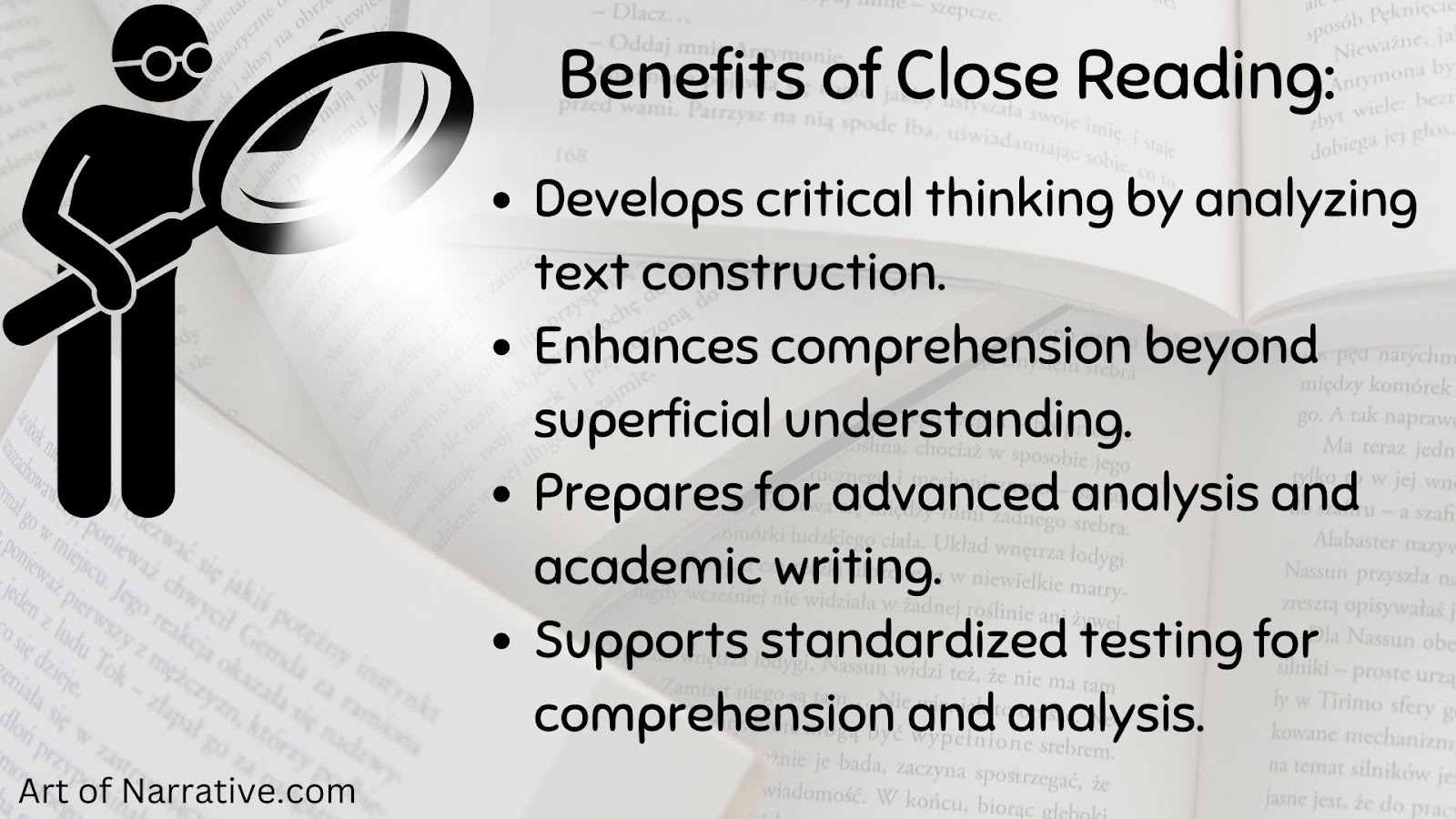
Close reading benefits students in several ways:
- Develop Critical Thinking: Students learn to think critically about authors’ choices by analyzing how a text is constructed.
- Enhances Comprehension: Close reading helps students go beyond a superficial understanding of a text and delve into its deeper meaning.
- Prepares for Advanced Analysis: Close reading skills are foundational for higher-level literary analysis and academic writing.
- Supports Standardized Testing: Many assessments, such as SAT and ACT, require close reading skills for comprehension and analysis questions.
Planning a Close Reading Lesson
When planning a close reading lesson, consider the following steps:
- Select an Appropriate Text: Choose a short, challenging text or excerpt that offers multiple layers of meaning. Poetry, excerpts from novels, speeches, or complex informational texts work well.
- Define Learning Objectives: Set specific goals for what students should be able to do after the lesson, such as identifying themes, analyzing literary devices, or understanding the author’s purpose.
- Determine Key Focus Areas: Decide which aspects of the text to emphasize (e.g., language, tone, symbolism). This focus will guide the questions and activities you design.
- Prepare Guiding Questions: Develop questions encouraging students to dig deeper into the text. Include a mix of literal, inferential, and evaluative questions.
- Plan Annotations or Activities: Decide how students will engage with the text—through annotation, group discussions, or written responses.
- Teaching Close Reading: Strategies and Techniques
Here are some strategies for conducting a close reading:
- Model the Process: Begin by demonstrating how to read a short passage closely. Think aloud as you annotate, showing how you notice keywords, ask questions and make connections.
- Chunk the Text: Break the text into manageable sections. This allows students to focus on specific details without feeling overwhelmed.
- Annotate the Text: Teach students to highlight or underline key phrases, write marginal notes, and circle unfamiliar words. Annotation helps them engage actively with the text.
- Read Multiple Times with Different Focuses:
- First Reading: Aim for general understanding and identification of the main idea.
- Second Reading: Focus on specific literary elements, such as word choice, tone, or figurative language.
- Third Reading: Review deeper analysis, considering the text’s themes and implications.
- Use Text-Dependent Questions: Ask questions that require students to return to the text for answers. These questions should encourage exploration of details, such as:
- What is the significance of this word choice?
- How does this passage contribute to the development of the theme?
- What tone does the author use, and how does it shape the meaning?
- Guiding Students Through the Close Reading Process
To support students as they develop close reading skills, guide them through these steps:
- Step 1: Pre-Reading
- Provide background information or context to help students understand the text.
- Preview essential vocabulary that might be challenging.
- Step 2: First Read – Understanding the Gist
- Have students read the text independently to grasp the overall meaning.
- Discuss what the text is about and what they noticed.
- Step 3: Second Read – Analyzing Language and Structure
- Ask students to re-read the text, paying attention to the author’s language, tone, and stylistic choices.
- Encourage them to annotate the text, marking essential passages, questions, or surprising details.
- Step 4: Third Read – Deep Analysis
- Focus on uncovering themes, the author’s purpose, and the text’s implications.
- Use discussion or written responses to explore more profound interpretations.
- Step 5: Reflect and Connect
- Encourage students to relate the text to other readings, their own experiences, or broader themes in literature.
- Discuss how the text’s meaning changes when viewed through different perspectives.
Close Reading Activities for the Classroom
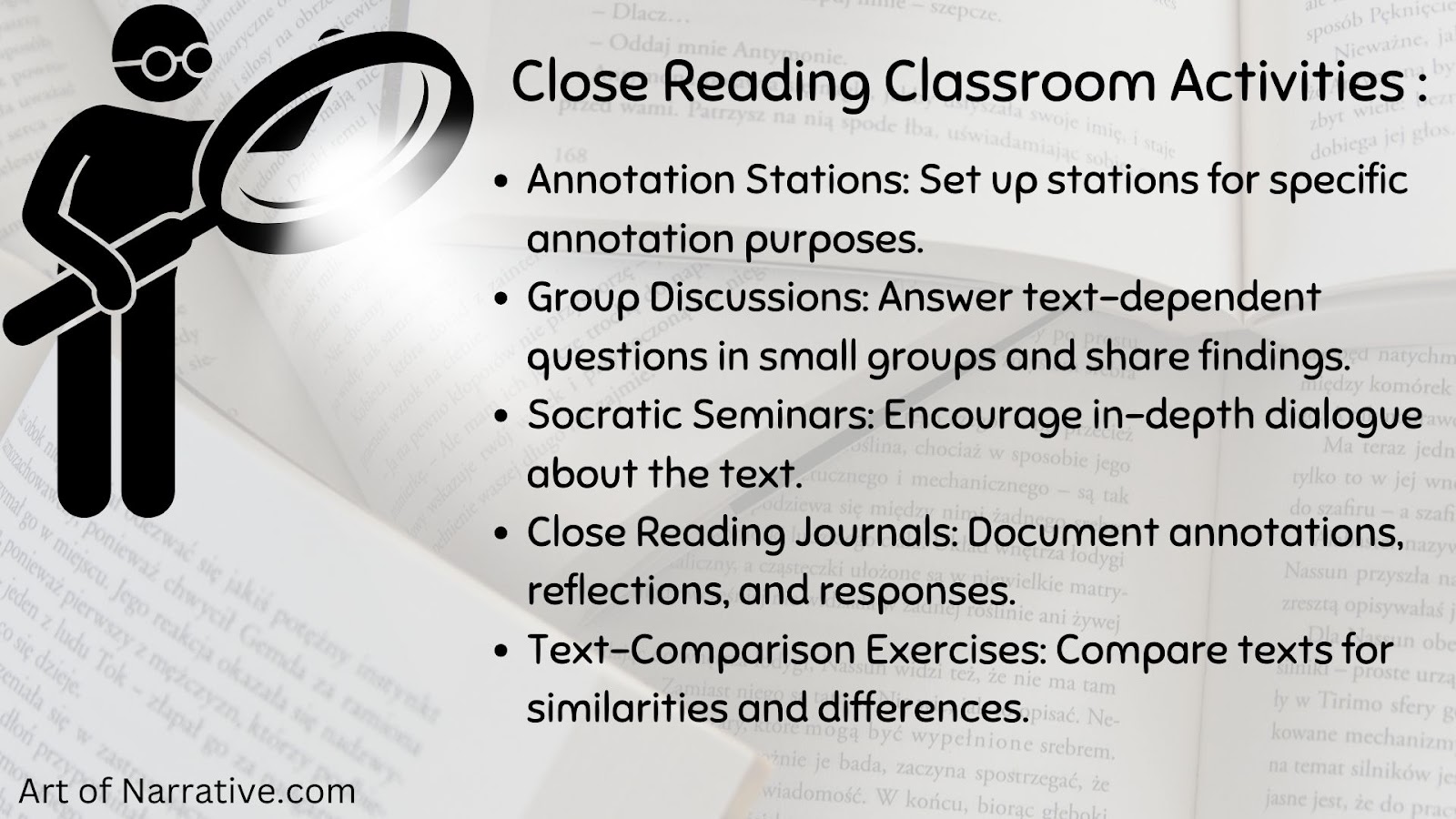
Incorporate these activities to make close reading interactive and engaging:
- Annotation Stations: Set up different stations where students annotate the text for specific purposes (e.g., imagery at one station and tone at another).
- Group Discussions: Have students work in small groups to answer text-dependent questions, then share their findings with the class.
- Socratic Seminars: This discussion method fosters in-depth dialogue about the text. Encourage students to ask and respond to open-ended questions.
- Close Reading Journals: Have students keep a journal to document their annotations, reflections, and responses to guiding questions.
- Text-Comparison Exercises: Compare the primary text with another related text to analyze similarities and differences in themes, language, and structure.
Assessing Close Reading
To evaluate students’ close reading skills, consider the following methods:
- Annotations and Notes: Review students’ annotations for evidence of critical thinking and engagement with the text.
- Written Responses or Essays: Have students write analytical paragraphs or essays based on their close reading, citing evidence to support their interpretations.
- Class Participation: Observe students during discussions for their ability to support their points with textual evidence.
- Quizzes on Specific Passages: Create quizzes focusing on understanding particular passages and their significance.
Addressing Common Challenges
Students may struggle with close reading for various reasons. Here’s how to address common challenges:
- Difficulty Understanding Complex Texts:
- Break the text into smaller sections.
- Provide guiding questions for each section.
- Over-Reliance on Teacher Guidance:
- Gradually reduce the amount of support, encouraging students to apply close reading techniques independently.
- Encourage peer discussions where students can help each other.
- Struggling with Annotation:
- Provide a list of annotation symbols or prompts to help guide students’ annotations.
- Model effective annotation practices regularly.
- Lack of Engagement:
- Choose high-interest or relatable texts.
- Allow students to select texts for some close reading assignments.
Close Reading Resources for Teachers
Consider using these resources to support your close reading lessons:
- Online Tools: Platforms like CommonLit, Newsela, or ReadWorks offer texts with built-in close reading questions.
- Close Reading Graphic Organizers: Use organizers that guide students in annotating texts, noting themes, and identifying literary elements.
- Books on Close Reading: Texts like Notice and Note: Strategies for Close Reading by Kylene Beers and Robert E. Probst provide insights and strategies for teaching.
Close reading is a fundamental skill in literary analysis. It allows readers to engage deeply with texts and uncover their hidden layers. One can reveal the complexities and beauty of written works by paying close attention to language, structure, and literary devices. Whether applied in academic settings or personal reading, mastering close reading enriches the experience of literature and enhances one’s ability to think critically.
References:
Fun Ways To Learn The 50 States With Kids. https://www.homeschoolof1.com/50-states/
Beers, Kylene, and Robert E. Probst. Notice and Note: Strategies for Close Reading. Heinemann, 2012.
