
 By
By During middle school English classes, your teacher probably drew a triangle on the board, labeled it with five keywords, and called it the “story pyramid.” You might have scribbled it in your notebook and moved on, but that simple triangle is actually a 200-year-old storytelling framework known as Freytag’s Pyramid. But what is Freytag’s Pyramid?
What is Freytag’s Pyramid?
Freytag’s Pyramid is a framework for analyzing the structure of a story, particularly in drama and fiction. Named after the German playwright Gustav Freytag, who developed it in the 19th century, this model breaks down the narrative into five key parts:
| Exposition | Rising Action | Climax | Falling Action | Resolution |
| sets the scene, introduces the main characters, and provides background information | a series of events that create suspense, tension, and interest | the peak of the narrative arc, where the main conflict reaches its most critical point | the peak of the narrative arc, where the main conflict reaches its most critical point | ties up loose ends, resolves the conflict, and provides closure |
What are the 5 stages of Freytag’s Pyramid?
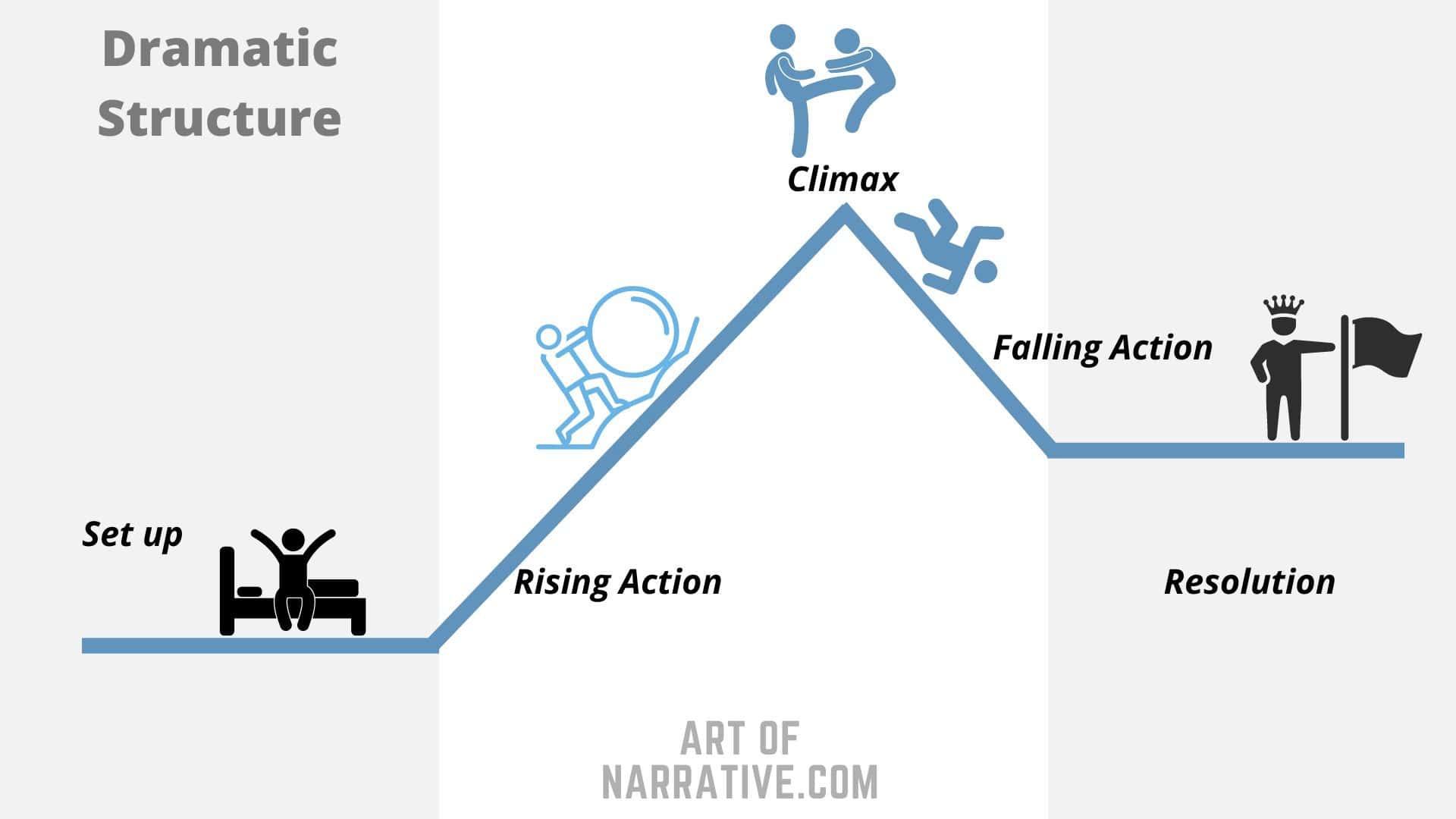
Here’s a breakdown of each stage of Freytag’s Pyramid:
Fraytag’s Pyramid exposition:
The exposition is the introduction of the story. It sets the scene, introduces the main characters, and provides background information. This is where the audience learns about the setting, the protagonist’s situation, and any important context needed to understand the story’s initial circumstances. The main conflict is often hinted at or introduced here.
Fraytag’s Pyramid Rising Action:
The rising action consists of events that create suspense, tension, and interest. It develops the story’s central conflict and complicates the protagonist’s journey. The rising action builds momentum as challenges and obstacles emerge, making the conflict more intense and leading up to the climax.
Fraytag’s Pyramid Climax:
The climax is the story’s turning point and the moment of greatest tension. The peak of the narrative arc is where the main conflict reaches its most critical point. The protagonist faces their biggest challenge, and the outcome of the conflict is decided here. The climax is often the most emotionally charged part of the story.
Fraytag’s Pyramid Falling Action:
The falling action follows the climax and shows the consequences of its events. The tension decreases, and the story starts moving towards resolution. This phase often involves unraveling the conflict, with characters reacting to the climax’s events and beginning to resolve the remaining issues.
Fraytag’s Pyramid Resolution (denouement):
The resolution, or denouement, is the conclusion of the story. It ties up loose ends, resolves the conflict, and provides closure. The characters’ futures are often hinted at, and the story reaches a stable state. The resolution brings the narrative full circle, often returning to a sense of normalcy or establishing a new equilibrium.

What is the significance of the Freytag Pyramid?
The significance of Freytag’s Pyramid lies in its ability to provide a clear, structured framework for understanding and analyzing the narrative arc of a story. Here’s why it’s important:
- Story Structure and Analysis: Freytag’s Pyramid helps writers, critics, and readers break down a story’s components into manageable sections. This model makes it easier to analyze how a story is constructed, how tension is built, and how the narrative progresses from beginning to end.
- Guidance for Writers: Freytag’s Pyramid offers a roadmap for crafting a compelling narrative for writers, especially those new to storytelling. By following the Pyramid’s stages, writers can ensure that their stories have a well-defined beginning, middle, and end, with a balanced progression of tension and resolution.
- Understanding Audience Engagement: The Pyramid emphasizes the importance of rising action and climax in maintaining audience engagement. It shows how building tension and leading up to a dramatic climax can keep readers or viewers invested in the story.
- Historical Perspective: Freytag’s Pyramid provides insight into classical storytelling techniques, particularly in drama and literature. It reflects the narrative structure that is effective in Western storytelling traditions, dating back to ancient Greek tragedies.
- Teaching Tool: In education, Freytag’s Pyramid is a valuable tool for teaching students about narrative structure. It simplifies the complexities of storytelling and helps students identify the key elements that make up a cohesive and effective story.
- Application Across Mediums: While initially developed for analyzing dramatic works, Freytag’s Pyramid is applicable across various storytelling mediums, including novels, films, television shows, and even short stories. It’s a versatile model that can be adapted to different types of narratives.
In short, Freytag’s Pyramid is significant because it distills the essence of storytelling into a universal structure, making it easier to create, analyze, and appreciate stories across different contexts.

What does Freytag’s Pyramid describe?
Freytag’s original model was designed specifically to describe the structure of classical tragedies. Gustav Freytag, a 19th-century German playwright and novelist, studied the works of ancient Greek and Shakespearean tragedies, and his Pyramid reflects the narrative arc commonly found in these dramatic forms.
Let me show you how this works with a quick breakdown of Shakespeare’s tragedy Macbeth:
Exposition:
The play opens with the three witches on a Scottish heath, setting a dark and ominous tone. Macbeth is introduced as a brave and loyal general, and King Duncan praises him for his bravery in battle. The witches prophecy that Macbeth will become king, planting the seed of ambition in his mind.
Rising Action:
Spurred by the prophecy and encouraged by his wife, Lady Macbeth, Macbeth plots to kill King Duncan to seize the throne. The tension rises as Macbeth wrestles with his conscience but ultimately murders Duncan. Afterward, he becomes increasingly paranoid, committing further atrocities to secure his power, including the murder of Banquo and the massacre of Macduff’s family.
Climax:
The climax occurs when Macbeth sees Banquo’s ghost at the banquet, revealing his deepening madness and guilt. This event marks Macbeth’s power unraveling as his fear and paranoia take over. It’s the peak of his tragic flaw—unchecked ambition—leading him to a path of inevitable destruction.
Falling Action:
Following the banquet scene, Macbeth’s reign becomes increasingly unstable. The opposition against him grows, with Macduff and Malcolm (Duncan’s son) leading an army to overthrow him. Lady Macbeth, overcome with guilt, descends into madness and eventually dies, further isolating Macbeth.
Resolution (Denouement):
The play concludes with Macbeth’s downfall. In the final battle, Macbeth is confronted by Macduff, who reveals that he was “not of woman born” (a technical loophole in the witches’ prophecy). Macbeth is killed, and Malcolm is restored to the throne, bringing order back to Scotland.
However, Freytag’s Pyramid has been adapted and applied more broadly to various narratives, not just tragedies. While the model originally focused on the rise and fall of tragic heroes, modern interpretations use it as a general framework for analyzing all sorts of stories, including comedies, dramas, and other genres.
Freytag’s Pyramid in Tragedies:
- Tragedies often feature a protagonist who encounters a series of escalating conflicts (rising action), leading to a catastrophic climax (the protagonist’s downfall). This event is followed by unraveling events in the falling action and, finally, a resolution that often involves the hero’s demise or a significant loss.
Freytag’s Pyramid in Other Genres:
- In Comedies, the climax might be a humorous misunderstanding or a peak in the romantic tension, followed by a resolution that ends in marriage or reconciliation instead of a downfall.
- In Dramas or Adventure Stories, the climax might involve a hero overcoming a significant obstacle, with the falling action and resolution leading to a happy or bittersweet ending.
- In Thrillers, the rising action builds suspense, the climax is a shocking revelation or a confrontation, and the resolution ties up loose ends, possibly with a twist.
Limitations:
- Freytag’s Pyramid is most effective in analyzing narratives that follow a linear, chronological structure with a clear rise and fall of action. It might be less applicable to stories with non-linear plots, multiple protagonists, or experimental narratives. In other words, try to explain a Christopher Nolan film with this model, and you’ll probably sound like an idiot.
In summary, while Freytag’s Pyramid was originally intended to describe the structure of tragedies, it has been widely adopted to describe the structure of many different types of stories. The critical elements of exposition, rising action, climax, falling action, and resolution can be found in various narrative forms, making the Pyramid a versatile tool for storytelling analysis.
Freytag’s Pyramid story example
Here’s an example of Freytag’s Pyramid applied to the classic fairy tale “Beauty and the Beast.”
Exposition:
The story begins with Belle, a kind and intelligent young woman who lives in a small village with her father, an eccentric inventor. Belle feels out of place in her town, where people see her as odd because of her love for books and her dreams of adventure. Once a handsome prince, the Beast lives in a distant castle, cursed to remain in his monstrous form until someone loves him despite his appearance. The curse also transformed his servants into enchanted objects.
Rising Action:
Belle’s father, Maurice, becomes lost in the forest and stumbles upon the Beast’s castle. The Beast imprisons him for trespassing. When Belle learns of her father’s plight, she offers to take his place, and the Beast accepts. Initially, Belle and the Beast have a strained relationship, but over time, Belle’s kindness softens the Beast’s heart. Meanwhile, back in the village, the arrogant hunter Gaston plots to marry Belle and, upon hearing Maurice’s tale of the Beast, plans to kill the Beast.
Read more about rising action.
Climax:
The climax occurs when Belle realizes she has developed feelings for the Beast. Just as the Beast allows her to leave to care for her ailing father, Gaston leads a mob to attack the castle. In the ensuing battle, Gaston and the Beast face off, and the Beast is gravely wounded. Gaston falls to his death. As the Beast lies dying, Belle confesses her love for him.
Falling Action:
Belle’s declaration of love breaks the curse, and the Beast transforms into a handsome prince. The enchanted objects in the castle also return to their human forms, and the castle, once dark and foreboding, becomes bright and beautiful again.
Read more about falling action.
Resolution (Denouement):
The story concludes with the prince and Belle joyfully reunited. They return to the village, where the townspeople warmly receive them. Belle’s dream of adventure and love has come true, and the prince is finally free of his curse, living happily ever after with Belle by his side.
FreyTag’s Pyramid Template PDF
This worksheet helps users understand the structure of a story according to Freytag’s Pyramid, guiding them through each stage of the narrative. It can be used in classrooms, writing workshops, or personal storytelling exercises.
Conintue Reading:
Freytag’s Pyramid– Masterclass
Gustav Freytag– Britannica
